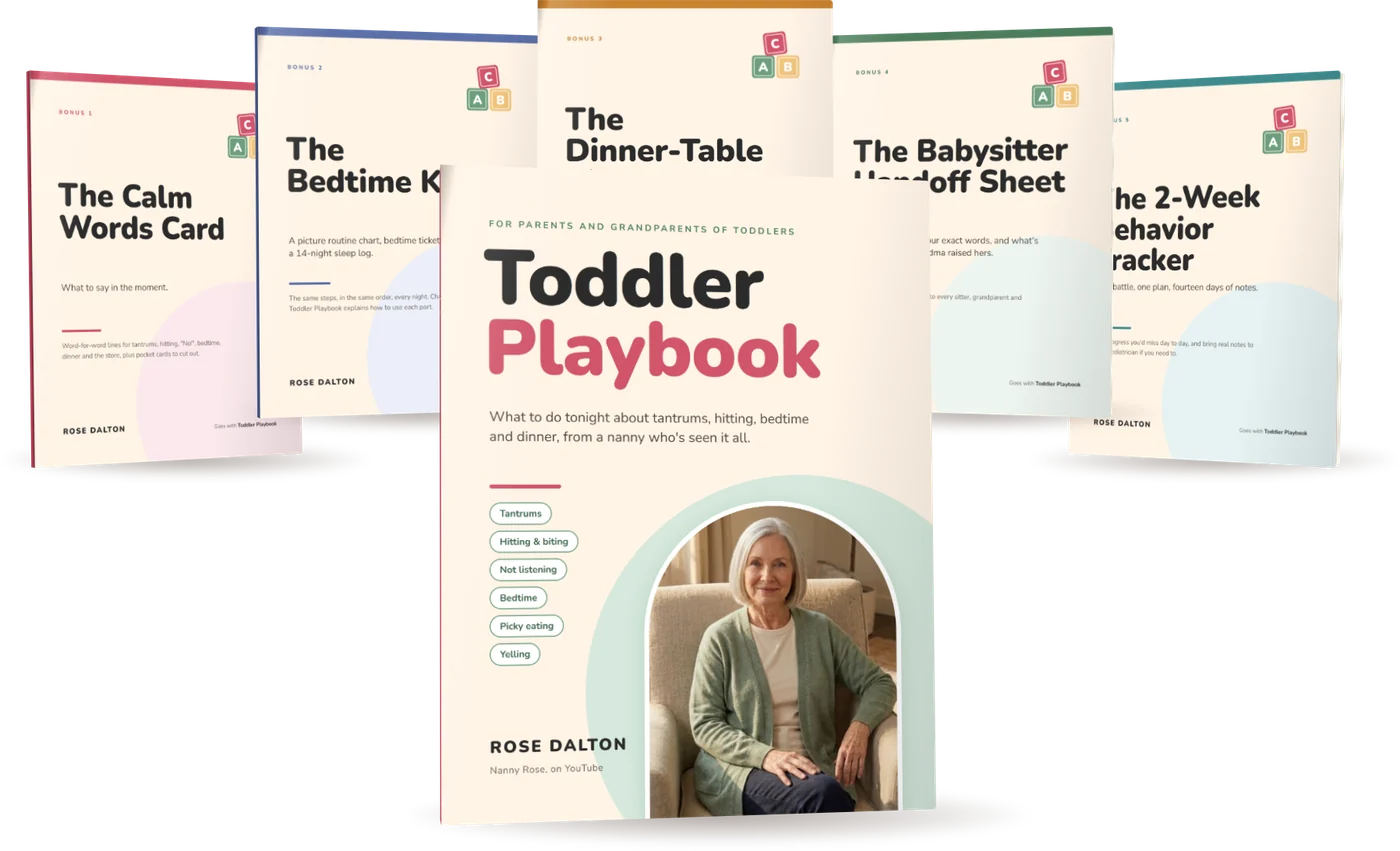
Meltdowns over the wrong color. Yelling and feeling the guilt. Bedtime that feels like a nightly war. You're not alone: in a big study, 84 in 100 3-5 year olds had a tantrum in the past month. Toddler Playbook gives you one calm plan and the exact words to say for tantrums, bedtime and dinner, from a nanny who's seen it all. Best part? It costs less than one box of diapers.
"Yelling doesn't make you a bad parent. It makes you a parent who had a hard moment."
From Chapter 12
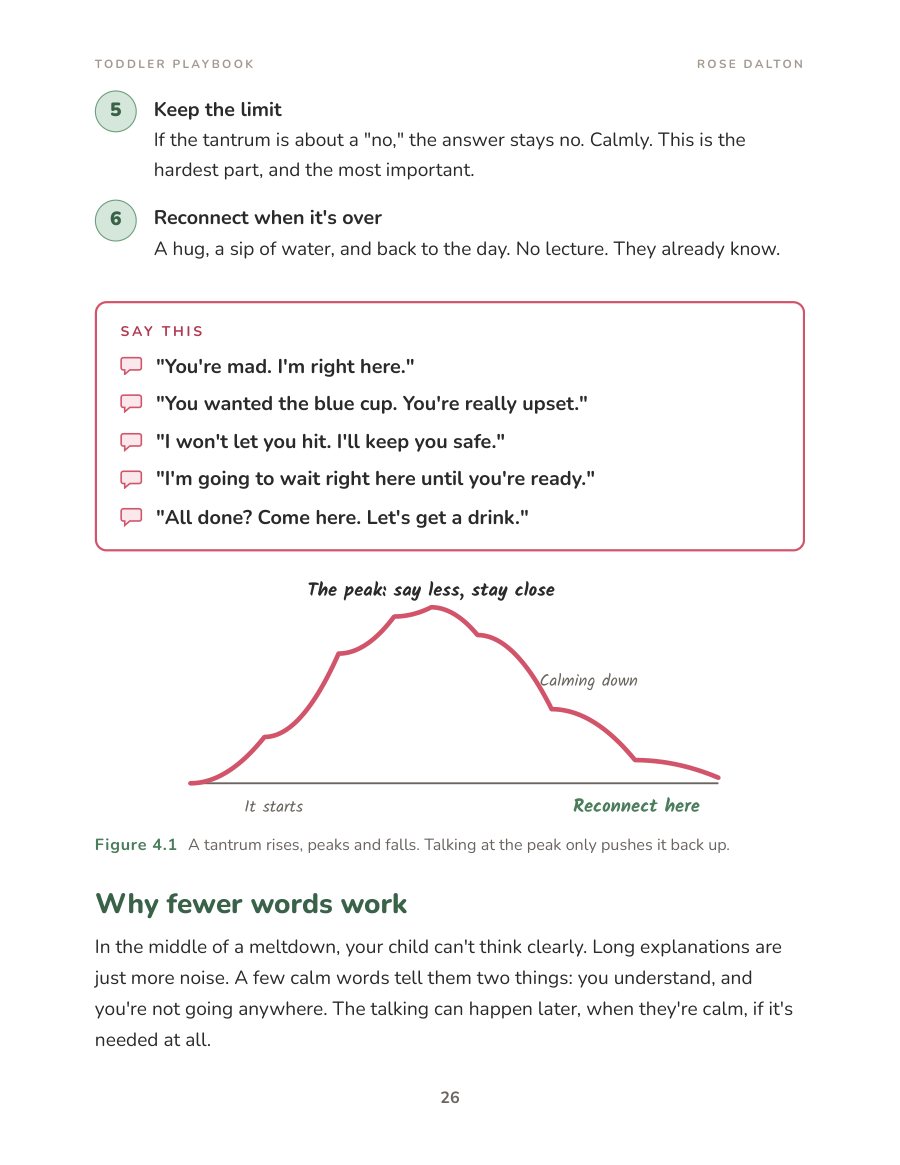
The wrong color cup. A sandwich cut the wrong way. A no at the store. Most tantrums actually last a few minutes, but when they come every day, you're worn down before dinner.
You snap, they cry, and later you lie awake wondering if you've done damage. Nearly every parent has been there. It doesn't make you a bad parent. What matters most is what you do next.
Sticker charts, time-outs, gentle talks. Monday you hold the line. Wednesday you're too tired and give in. By Friday, your toddler knows a no only means maybe if they scream long enough.
None of that means something is wrong with you or your child. A toddler's feelings are big and their words are small. The answer isn't another philosophy. It's one plan, the same words every time, and a grown-up who stays calm most of the time and makes up afterward when they don't.
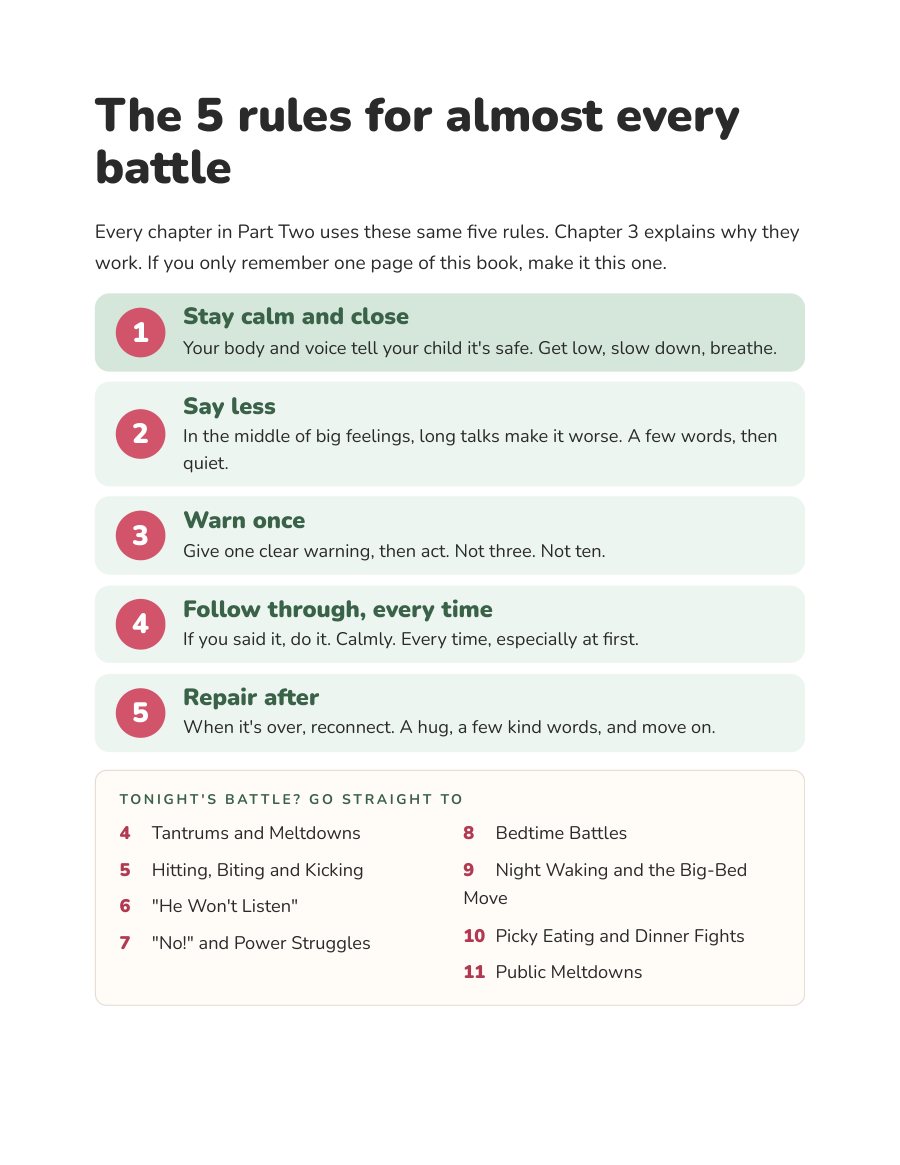
You don't have to learn a new system for every problem. Every chapter in the playbook uses the same five rules, for tantrums, hitting, bedtime, dinner and the grocery store.
Get low, slow down, breathe
A few words, then quiet
Not three times. Not ten.
If you said it, do it. Calmly.
Reconnect, then move on
What's normal, what temperament really means, and why your calm is the strongest tool you have.
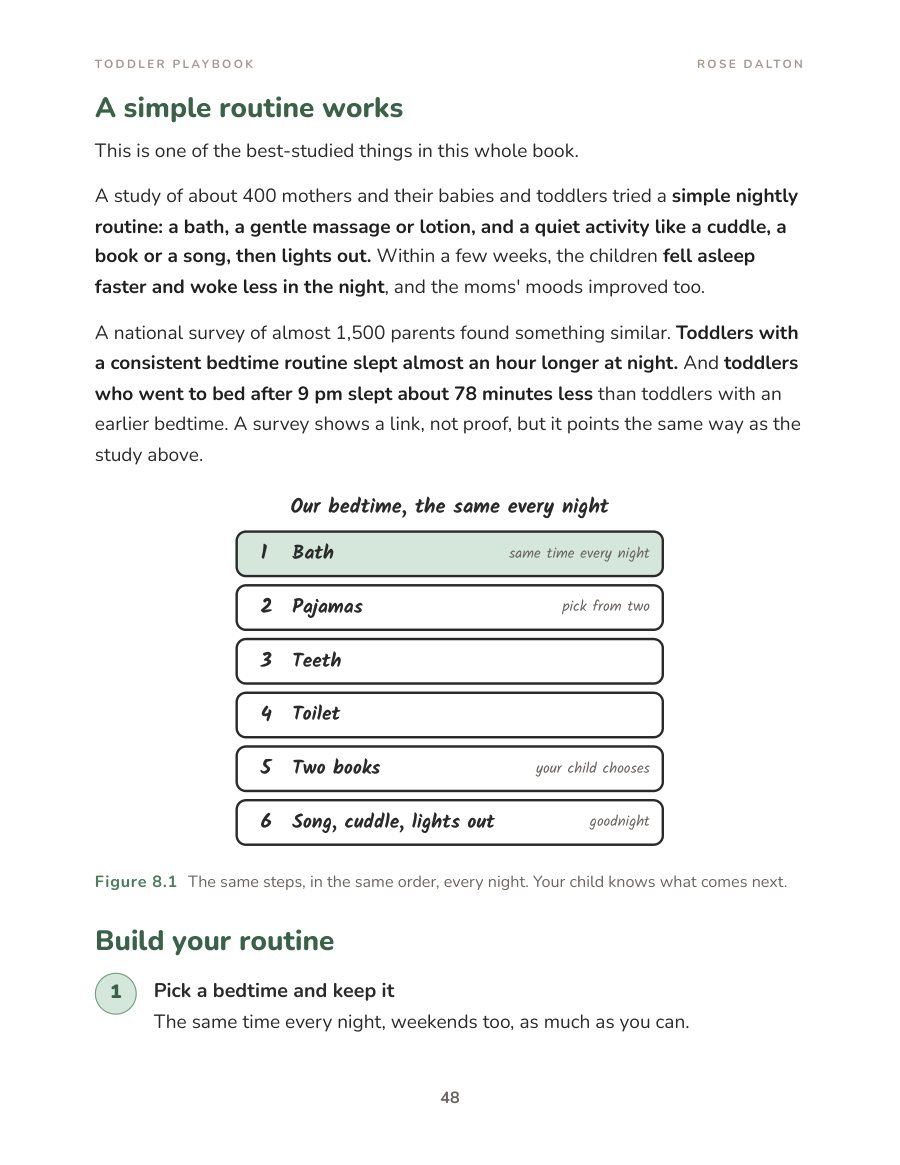
Tantrums, hitting, not listening, "No!", bedtime, night waking, dinner and public meltdowns. Each chapter gives you the words to say and a plan for tonight.
When you've yelled, getting the grown-ups on the same page, when to call your pediatrician, and your one-page plan.
All the common mistakes in one place, a quick-find for "what's happening right now?", and the full list of sources.
These are real pages from the book. Every chapter in Part Two follows the same pattern, so you always know where to look: what's normal, what to do, what to say, and what to expect.
Swipe to see more →


It gives you one plan and the exact words for the battles that wear you down most. Every chapter follows the same pattern: what's normal, what to do tonight, what to say, what to expect, and when to call your pediatrician. It's written from the American Academy of Pediatrics' guidance and published research, and it tells you plainly when something is a tested finding and when it's a trick that simply works for a lot of families.
It won't end tantrums. Nothing does: they're a normal part of being small. Temperament is real, and some children take longer. What a steady plan can do is make the hard moments shorter and calmer for many families, and help you stay calmer during them. It isn't medical advice, and it can't diagnose your child.

"What helps isn't a perfect parent. It's a simple plan, the same words every time, and a grown-up who stays calm most of the time and makes up afterward when they don't."
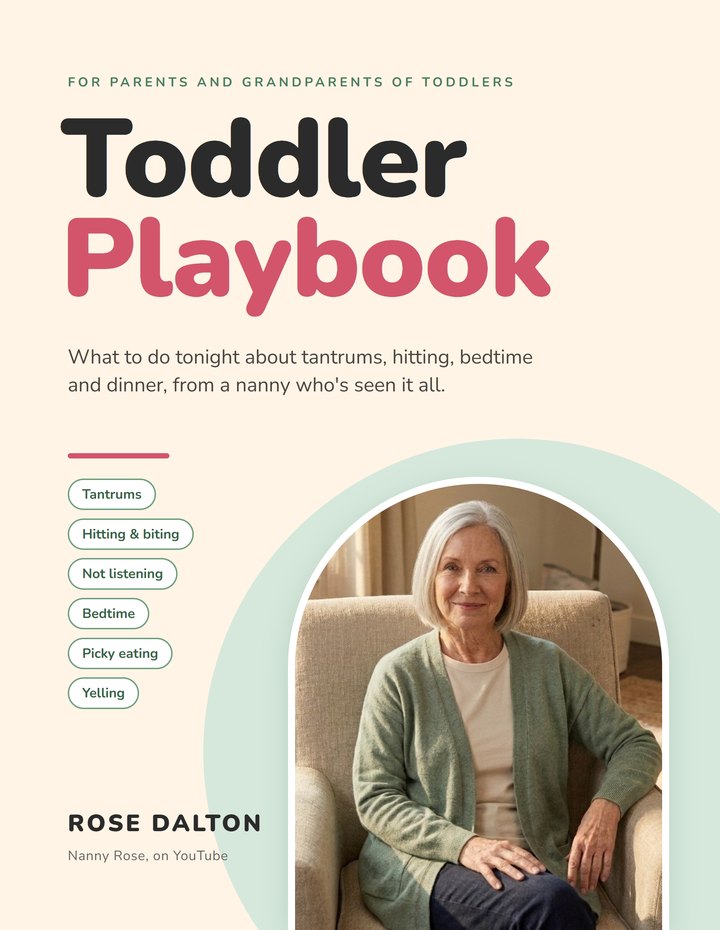
Rose has been looking after other families' little ones since she was about 20, as a nanny and a babysitter. Along the way she raised three children of her own, and now she's a grandmother too. On the Nanny Rose channel, she shares calm, practical help for the toddler years.
Rose isn't a doctor or a nurse, and she doesn't pretend to be. That's why the book sticks to what the pediatricians' guidance and the research say, and tells you exactly when to call yours.
Neither. The book's middle path is calm and firm: a quiet voice, a few words, and a limit that doesn't move. Chapter 3 shows why calm without follow-through gets ignored, and loud without calm brings more pushback.
Temperament is real. Research suggests genes explain somewhere between a fifth and three-fifths of it. The rest comes from experience, and that's where a steady plan helps. Strong-willed kids often need more warning before changes, more time to calm down and more repetition, and Chapter 2 shows how to adjust.
It's short on purpose, and you don't read it cover to cover. Read Part One, then turn to the chapter for tonight's battle. Each one gives you the exact words, the steps in order, and what the first few nights usually look like.
Toddlers and preschoolers, roughly 1 to 5. Most of the research behind it looked at children in that range, and the sleep chapter gives the recommended hours for 1- to 2-year-olds and for 3- to 5-year-olds.
Yes. Chapter 13 is about getting every grown-up on the same page, kindly. The Babysitter Handoff Sheet has a gentle page called "What's changed since we raised ours" that you can share, or that someone can share with you.
It doesn't recommend spanking. The American Academy of Pediatrics advises parents not to spank or hit children, and Chapter 3 explains why. For sleep, Chapter 9 covers what a five-year follow-up study found about gentle sleep techniques, plus a calm middle-of-the-night plan. You choose what fits your family.
The book is built for tired parents. Pick one battle, run one plan for two weeks, and let the rest wait. Most "Try this tonight" steps take a few minutes.
Yes. The book comes as a PDF and an EPUB. The PDF looks like the printed page and prints cleanly at home. The EPUB is made for phones and e-readers like Kindle, Kobo and Apple Books, and the text resizes to whatever is easiest for you. The 5 bonuses are print-ready PDFs, each with an EPUB reading copy too.
Checkout runs through a secure payment page. Your download links arrive right away on the confirmation page and in your email.
Read Part One tonight, pick your hardest battle, and use the plan at the next meltdown.
The book plus all 5 bonuses, for a one-time . Pick your hardest battle and run the plan for a month. If it doesn't make your days easier, email me for a full refund, no questions asked, and keep everything.
Includes: Toddler PlaybookCalm Words CardBedtime KitDinner-Table PlanBabysitter Handoff Sheet2-Week Behavior TrackerTotal value · yours for